reuse artist in residency - month one recap
I am officially one month into my Austin Creative Reuse residency, with three more months to go.
I've been keeping a studio notes blog throughout the residency, so there is a trail of experiments, research rabbit holes, things that worked, things that didn't you are interested in the details.
But here I’d like to share the broad strokes.
Where I started
I applied to the residency with this body of work in mind.
I've been interested in the kind of grief that comes from witnessing environmental changes and loss. You can see the headlines about warming oceans, disappearing insects, habitat loss, plastic pollution, and species decline, but there isn't necessarily a traditional way for mourning those kinds of things.
Mourning jewelry gave me a place to start.
I began researching historical mourning practices and thinking about what it might mean to translate some of those traditions through the materials I already work with: discarded plastic and reused objects.
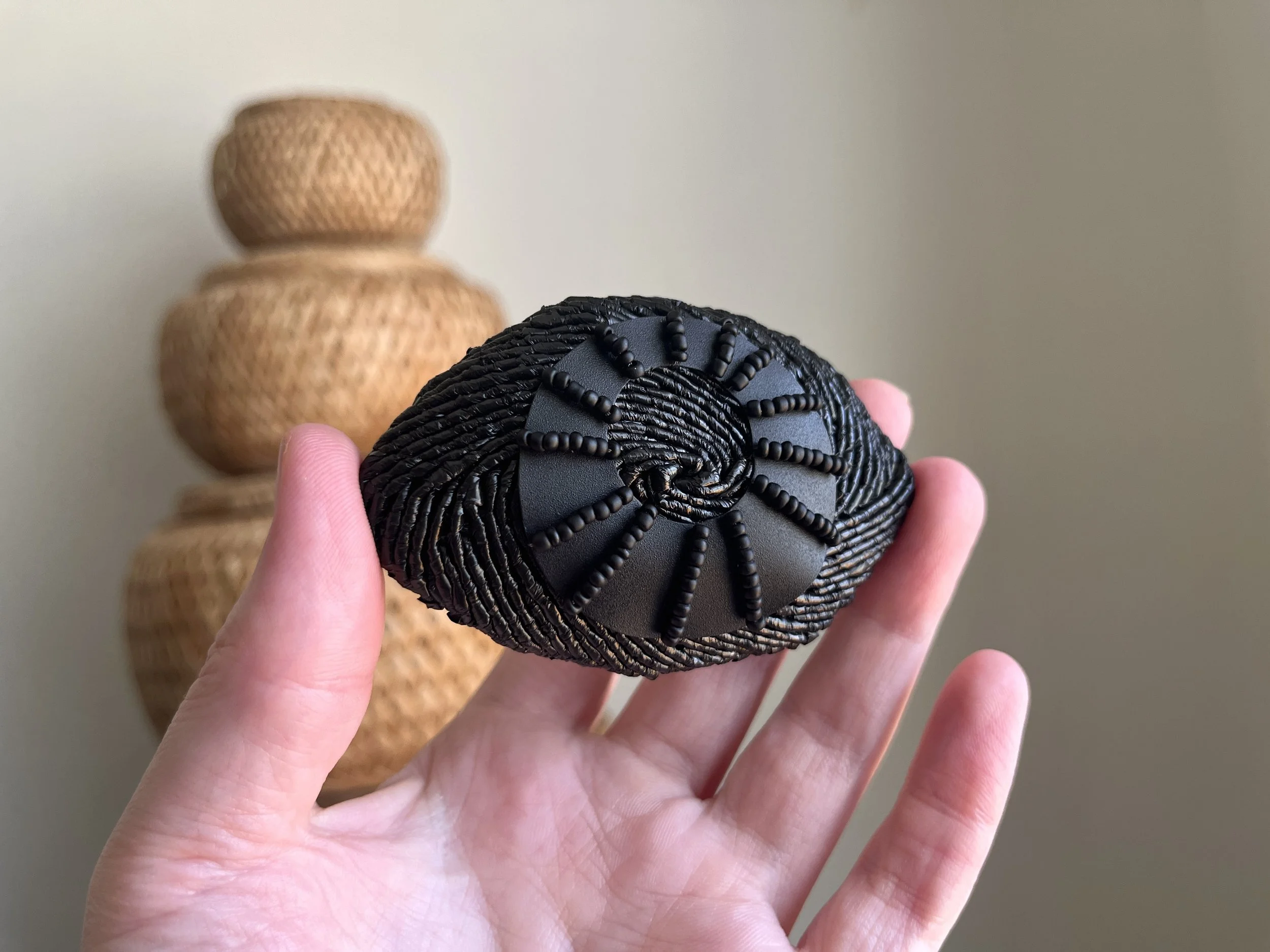
Before the residency
I started with macramé. I explored a shape often used in mourning jewelry, the navette, and saw it as an eye and potentially a symbol for bearing witness to the grief itself.
I wasn't completely happy with the first version, which is actually something I think is important to document. When you are used to making work within a familiar visual language, starting something new can feel surprisingly uncomfortable. There isn't a collection of previous successes telling you that you know what you're doing yet.
I started learning historical hairwork techniques and translating them from human hair into grocery bag “plarn”. This avenue of discovery helped me think about the relationship between using the “sacred remains” of hair in mourning jewelry and my use of plastic instead. The connection between hair of the loved one lost and the grief of the wearer feels like a direct and solid connection. Using waste plastics in the place of this feels less direct.
What does it mean to preserve something that wasn't connected to a particular person, but is connected to all of us as humans?
That led me to thinking about plastic as something that may remain long after we are gone. Something we created that could outlast us.
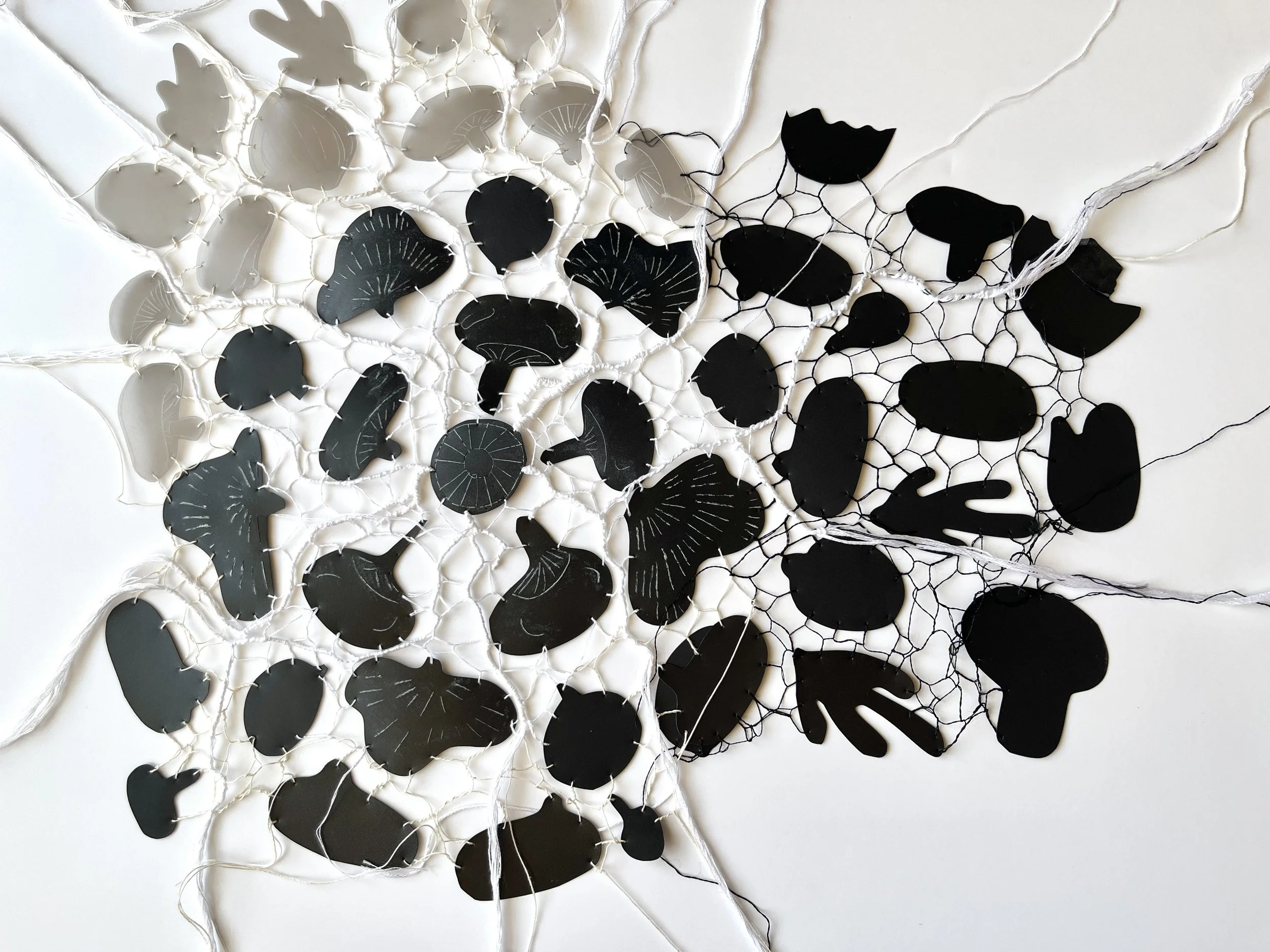
The mourning veil
I also started playing with the idea of creating a mourning veil, but using mushrooms as a symbol of decomposition and processing death. I was interested in the veil because it can do two things at once. It publicly communicates that someone is mourning while also creating a private space around the person wearing it.
I started with a paper prototype, drawing little white mushrooms on black paper and connecting them with black thread.
Just as my residency began, I started problem solving how to create a functional veil. I tried a lot of different potential solutions, but when I started learning needle lace it felt like the most elegant and historically appropriate technique.
At first, it was just a technical solution for connecting the plastic folders to create the veil. But then the stitches started looking like mycelium spreading through the veil and that changed the whole thing for me.
The veil is no longer just a field of mushrooms connected by something that happens to resemble lace. The lace itself becomes part of the mushroom imagery.
So now that I have settled on a technique, I am working through different design variables. Black or grey plastic folders for the mushrooms? white thread connecting and with mycelium? Black thread with white mycelium? Adding black paint to help transition between the mushrooms and the mycelium?
I only have a few more choices to make before starting the actual mourning veil.
This is what most of the work actually looks like right now: trying something, staring at it, deciding whether I can live with it, and trying something else.
Following the decomposers
The mushroom research also led me toward slime molds and other decomposers.
I'm interested in organisms that break things down and participate in the transformation and redistribution of what is left behind.
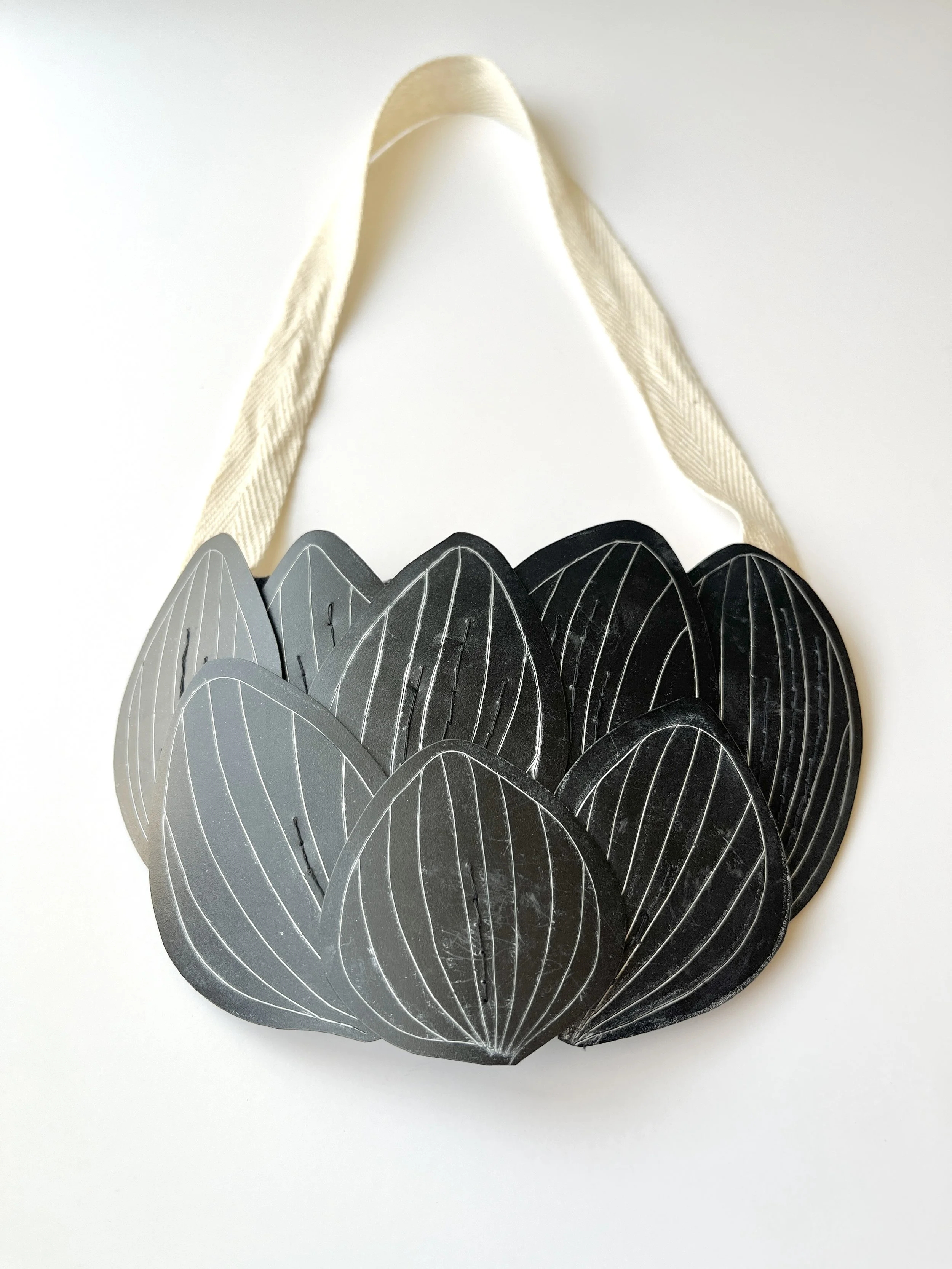
The first piece I finished this month was a necklace created with a black shoulder pad and black plastic folders cut to look like angel wing mushrooms.
The way this piece feels when I wear it was especially inspiring. When I put it on, it had a light, spread-out pressure that almost felt like a hand resting on my chest. It was so comforting.
I like the idea of creating a kind of armor necklace inspired by the exoskeleton of a beetle. I've been looking at carpet beetles for their beautiful textures and colors, but also hoping to borrow some of their connection to decomposition. I haven’t started on this design yet but it is being workshopped in my head.
Then the Blackland prairie entered the picture
More recently, I've started learning about the Texas Blackland prairie. It is an endangered ecoregion that I happen to live on. I've been especially interested how many of the plants are used by multiple species for nesting, food, shelter and even flood mitigation. The interconnectedness has been the idea that stands out the loudest.
At the same time, I've been learning about reliquaries and pilgrimage. One section of a book I am reading talks about people making pilgrimages to places that were important to them and bringing home small pieces of those places: oil, earth, rocks, and water.
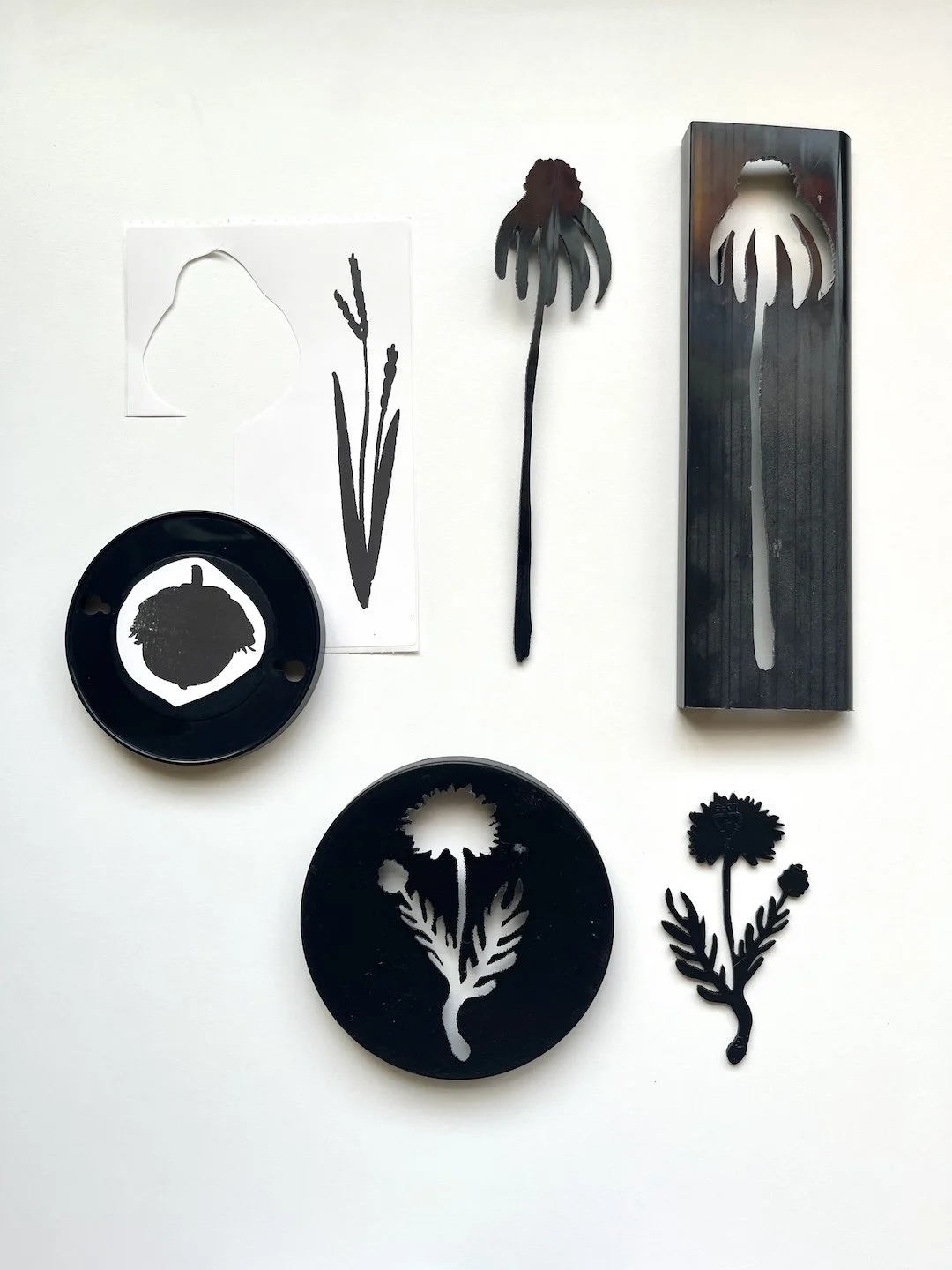
So I've started a new piece. I'm cutting silhouettes of plants from the Blackland prairie out of plastic collected from ACR and attaching them to individual stacking rings. So far I have a purple coneflower and prairie bundleflower. I just picked up some larger pieces of black plastic from ACR for the bluestem grass, and I want to create the root systems underneath the rings too.
The idea is that stacking the rings becomes a kind of pilgrimage through the Blackland prairie. Each ring is one small part of the ecosystem but they belong together.
I am cutting the plants from the plastic in a way that both the whole plastic and the cut out can be used and i’m thinking about making the whole plastic be a part of a wall piece.
And here we are a month later
When I look back at the first month, I can see how each idea brought me to the next. It's a bit of a trust fall, though.
It's been years since I invested this much time into a new body of work, and I'm so grateful for the opportunity this residency is affording me. I don't know exactly what these pieces will become yet, but I have enough threads to keep following. So at least for the next three months, that's what I'm excited to do!